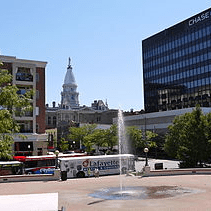
A van from the Vigo County Sheriff’s Department was parked next to the door the afternoon of the visit. A law enforcement officer from the department was seated at the desk — he was there because the building was burned in 2003 by a fool who thought he would avenge Timothy McVeigh.
It was a pleasure to meet Ms. Diamond Coleman, an intern at the museum. (By the way, she is with the Miss America organization and is working against sexual assault locally and for human rights at the state level.) She answered my question about the police presence, then guided me to the older exhibit, encouraging me to go through the hall to see the new exhibit, which featured a special traveling exhibit.
The burning question was how to avoid a repeat of the Hitler years here in the United States. While Hitler’s anti-Semitism and scapegoating of the Jews was plain in Mein Kampf, the platform that he ran on was Bread and Work, two quantities in short supply during the nadir of the Great Depression. He never won a majority of the vote, but President Paul von Hindenburg appointed Hitler Chancellor on January 30, 1933.
The Nazi Dictatorship Forms
February 1933 saw a campaign of Nazi terror against their opponents. The main actors were the storm troopers — part of the NSDAP (Nazi Party) apparatus tolerated by the official government. In early February, Nazi storm troopers attacked trade unions, Communists and the homes of left-wingers. The next victims, later that month, were the Social Democrats, whose meetings, speakers and leaders were attacked by brownshirts. Social Democratic papers were banned. Papers of the Center Party were banned in mid-Februrary. Brownshirts patrolled everywhere and the Nazis deputized 50,000 election “observers” from the SA and SS in Prussia. Göring gave orders that allowed police forces to shoot demonstrators, again in Prussia.
The Reichstag was burned on February 27 and a Dutch Communist was arrested for the arson, though there are reports that Hermann Göring boasted about setting it. Hitler seized on the fire to get von Hindenburg to sign off on the Reichstag Fire Decree. Hitler fomented fears that the Communists were about to carry out a putsch and rode it to the federal elections six days after the fire. Just to make sure, some 1700 Communists were thrown in jail and more papers were suppressed.
Germans went to the polls on March 3 and gave the Nazis a plurality. With their allies in the Reichstag, they had a bare majority. The Nazis arrested all 81 Communist deputies and prevented several Social Democrats from showing up. The Catholic Centre Party, some minor parties and a few Social Democrats perverted, and Hitler got his Enabling Act passed in late March. What remained of German democracy died with the act on March 27, 1933, eight weeks after Hitler became Chancellor.
 The Lafayette Sentinel