If you take the Amtrak train from Lafayette to Chicago, you may meet two retired men who volunteer their time and sleep to herd passengers into the station and thence to the platform. They were at their volunteer posts Thursday morning in the chilly pre-dawn dark.
Julius Walker is a retired letter-carrier from the US Postal Service. He greeted passengers at the Big Four depot, encouraging them to come in from the cold and keeping them informed about where the train was.
The train went through Cherry Grove (now just a place name), then Linden, then Romney. As the passenger train approached the neighborhoods on Lafayette’s southern fringe, Walker guided passengers to the elevator up and let them know about the other elevator down, for passengers must go up one elevator to the pedestrian bridge, cross over the busy tracks, then go down another elevator to the platform.
When passengers got off the down elevator and emerged onto the platform, Daniel Flavin greeted them and briefed them on the art of boarding a train: staying away from the tracks and letting the conductors bring heavy bags up the stairs. The infrared lights over the shelter and benches cut the morning chill. Flavin deserves some credit for this, for he designed the platform.
When Thursday’s train was at the station, Walker, having herded his charges to the second elevator, looked down from the bridge as they boarded the train.
Trump is not Hitler. The question that I wanted to answer by traveling to the CANDLES Holocaust Museum was how to keep a country that elected a man like Trump from following the path of Germany in the 1930s. Was there a way to keep Hitler from becoming, well, Hitler?
Hitler was active in German politics from before the publication of Mein Kampf, in which expounded his anti-Semitic views. Unlike Trump, he was politically prominent for at least eight years before becoming Chancellor. Instead of taking over an existing party and dealing with existing elites, his Nazi Party was new.
Three failures of the German polity perhaps bear most of the blame for letting the failed Austrian artist become the butcher of Central Europe. The first is the failure, deliberate or otherwise, of police to protect peaceful political gatherings from Nazi thuggery, which silenced people who were not pro-Nazi. Second was the slavish acquiescence of non-Nazis in passing the Enabling Acts, which required a two-thirds majority. Particular notice must be taken of the Catholic Centre Party, which suffered repressions in late Feburary 1933 but voted with their oppressor in March. Third was the inability of what civil organizations remained (the Lutheran and Catholic Churches) to organize against the regime at a time when the Kristallnacht provoked Germans into opposition to Nazism and the uglier forms of anti-Semitism.
So how does Terre Haute, Indiana get a Holocaust museum, in particular a Holocaust museum dedicated to one aspect of the Holocaust?
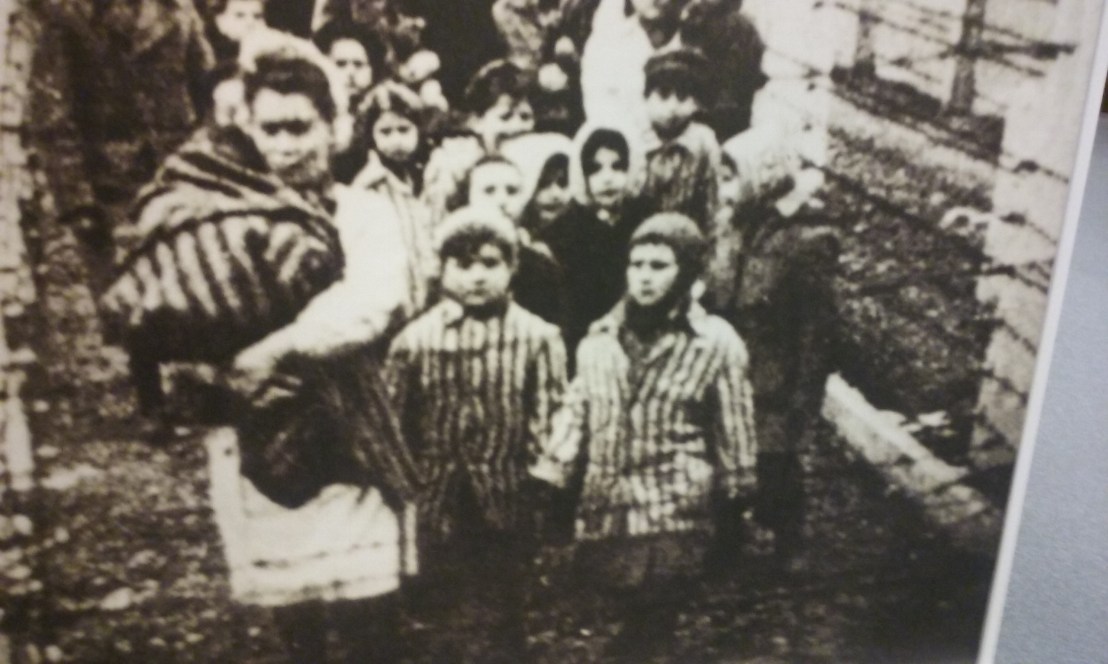
Miriam and Eva liberated
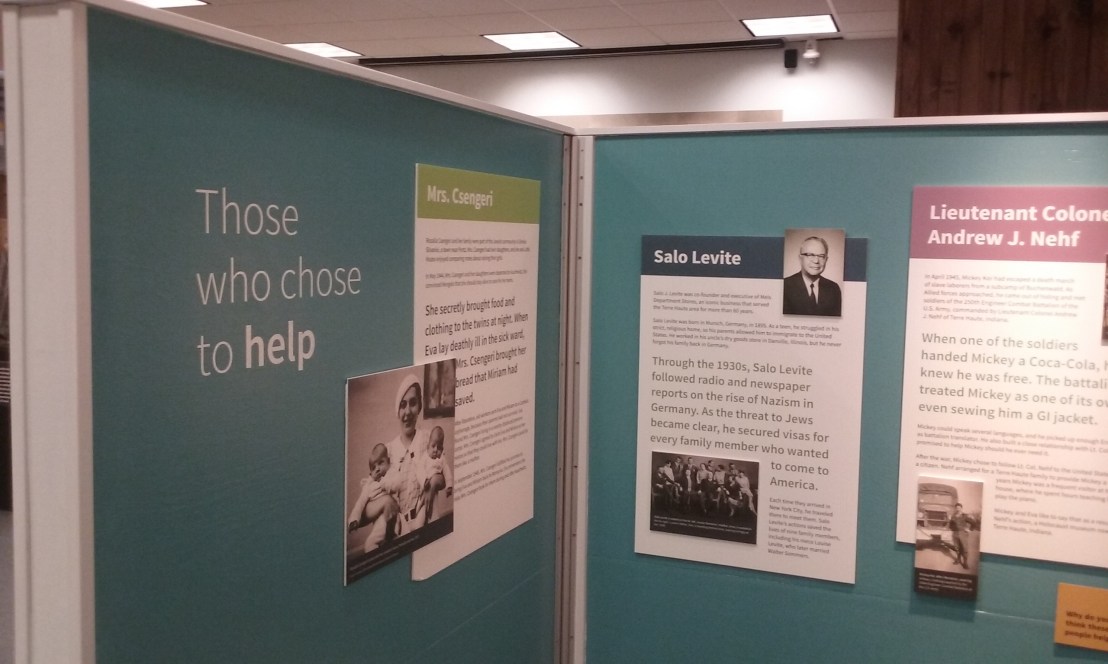
After their liberation by the Soviets in 1945, the Kor sisters were taken in by a convent in Katowice, Poland. One of their neighbors from Romania, Mrs. Rosalita Csengeri, tracked them down…
Rosalita Csengeri (L), Solo Levite (C), LTC Andrew J. Nehf (R)
As Romania sunk into Communism, the Kors relocated to Israel and thrived.
Lt. Col. Andrew J. Nehf was from Terre Haute, Indiana. When his division liberated Buchenwald, they sort of adopted Mickey Kor, a young prisoner who was fluent in several languages and served as an interpreter. Kor followed Lt. Col. Lehr back to Terre Haute, where Lehr help him adjust to life in the United States.
Kor travelled to Israel, met the Mozes twins, married Eva and returned to Terre Haute where they built their lives.
In 1978, a miniseries about the Holocaust raised awareness about it. Survivors of the Holocaust, who had kept silent, began to speak out. Eva and Miriam Kor set out to find the other Mengele Twins, founding the CANDLES institute to carry out the search. Eventually 122 individuals were found of the 1,500 “selected” for the experiments. A museum was founded in Terre Haute.
Meanwhile Eva Mozes Kor developed an intense urge to forgive her captors. This forgiveness is not any sort of condoning the acts, it is forgiving their perpetrators. As such Mrs. Kor has become a major exponent of forgiveness, forgiving the guards and sadists, “adopting” one of their grandchildren and speaking around the country about it.
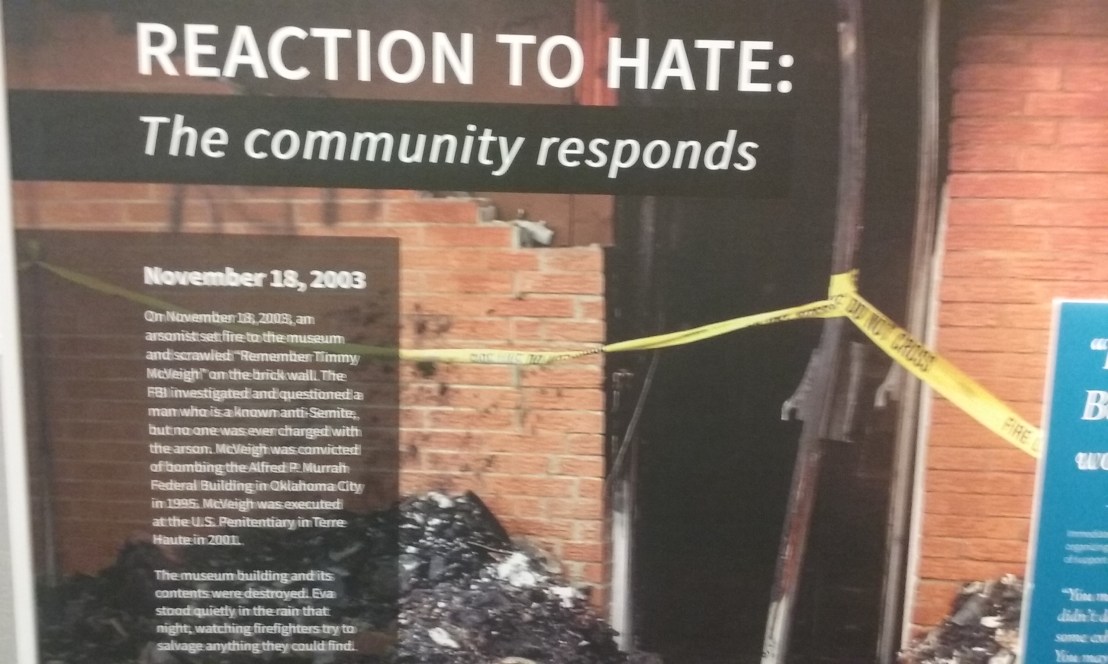
In 2003, one of the Oklahoma City bomber’s fanboys did this to avenge Timothy McVeigh, the Oklahoma City bomber executed at the Federal prison near Terre Haute:
CANDLES firebombed in 2003
The good people of Terre Haute and CANDLES simply built a larger facility, including this display that emphasizes the positive response of the Terre Haute community, including $25,000 raised by schoolchildren.
To finish the tour, here is a (not very good) photo of an experimental installation where people can ask questions of a virtual Holocaust survivor.
Pinchas Gutter is a Holocaust survivor, though not among the Twins. The USC Shoah Foundation created this exhibit, in which he was asked about 2,000 questions regarding the Holocaust and his answers were filmed. If you speak into the microphone (and the docent or intern are around), his avatar will respond to a closely related question. Mine was about what could have been done to stop Hitler — he said that it was important to keep nations from fighting other nations — it is an AI after all that decided which of the 2,000 questions should be answered.
Nancy Edwards was the volunteer docent on the day I visited. She has forty years of experience teaching German, which probably helps her in understanding the primary documents of the Holocaust. The questions I had for her were discussed in the first installment of the series, but the salient points bear repeating.
First, Germany was in a very bad place after World War I and the Depression. It should be added that the last Weimar administration chose to fight the depression with austerity, which brought the usual results of austerity during a depression.
Second, Germany was an intensely patriarchal society. Some of the flowering of Weimar culture was not, so the instinct to oppress was already there. The ideal was father in the workplace, mother in the home and children obeying authority figures without question. Hitler just had to become the “strong father” that such a system craves.
Third, Germans of the time did what they were told.
We disagreed on one point, though possibly because I was unclear. I believe that the step by step discrimination targeted against Jews and others were needed to pave the way for ever harsher measures, culminating in the Holocaust. Edwards believed that the responses of Germans were baked in by their culture — it should be mentioned that the Germans themselves have been trying to purge the second and third elements from German society, though with varied success.
When Germany started the European phase of World War II in 1939, it decided upon a final solution for “the Jewish problem”. In occupied Eastern Europe, the solution was to send out the Einsatzgruppen to carry out massacres of Jews, in some countries with local assistance. But the Einsatzgruppen, though monstrous, was not fast enough in its work, so a more “scientific” solution was developed.
The https://en.wikipedia.org/wiki/Wannsee_Conference on January 20, 1942 sketched out the plans for a coordinated extermination of Jews in Europe. Jews would be collected into ghettos (if they already were not), then deported from the ghetto to Poland for extermination. The healthier victims were used as slave labor and given enough food “to die more slowly” as the narrator in the comic Maus puts it. The young, the old and infirm were sent to the gas chambers, after being told that they were merely going to the showers. Periodically, the Nazis and their minions would conduct a “selection” in the barracks, condemning those who failed the physical test to the gas chambers.
Miriam and Eva Mozes were twins from Port, Romania. The Mozes family were the only Jewish family in Port, which was occupied by Hungarian Nazis in 1940. Their teachers encouraged fellow students to bully them, but the Kors avoided deportation until 1944, first to the ghetto and later to Auschwitz. While in the lines determining their fate, a Nazi guard asked Eva’s mother if the girls were twins. “Is that a good thing?”, said her mother.
While the twins were spared “selections”, the indignity of the striped uniforms and maybe got a bit more food, they spent six days per week as the subjects of “scientific research”, that is, sadists playing the role of mad scientist. On Mondays, Wednesdays and Fridays they were examined closely by “doctors” and “medical personnel” with little respect for their bodies. Tuesday, Thursdays and Saturdays were worse: a child would be injected with a mystery substance in one arm and a blood sample would be taken from the other arm. The substance could be drugs, vitamins or pathogens — the injections were painful and debilitating. After one “experiment” Eva was sent to her deathbed, but decided not to die and her body agreed.
A fuller story of these “experiments” can be found in this VICE story…which also describes Eva Mozes’ imprisonment, liberation from the Nazis, and as she might put it, the self-liberation that came from forgiving her guards and “doctors”.


 The Lafayette Sentinel