The path to Auschwitz ran through Evian: Part III of the CANDLES visit

The CANDLES museum details the steps that Nazi Germany took in the years from the Enabling Act on March 27, 1933 to the eve of World War II on the north wall of its exhibit.  Here are some of the steps that they mentioned, together with other steps taken from the Wikipedia.  The Holocaust did not spring full-form from Hitler’s brow, it was assembled piece by piece.  Jews and other “untermenschen” (under-men) were progressively shoved to the margins of German society.  The mechanics of extermination were tried out on political opponents and the disabled.

April 1, 1933:  Nazi boycott of Jewish businesses begins.

April 7, 1933:  Non-Aryans barred from legal practice and the civil service.

May 10, 1933:  Nationwide book-burning of “un-German” books taken from libraries and universities by the National Socialist Student League.

July 1933:  Naturalized German Jews stripped of citizenship.

July 14, 1933:  Compulsory sterilization of the disabled…just like in Indiana.

June 30 – July 2, 1934:  Night of the Long Knives.  The Nazis turned on the SA (Brownshirts, Party thugs) who brought them into power, killing dozen.  Members of the National Socialist party who were of its left wing were murdered, as were conservative Germans within and without the Nazi Party.  The Brownshirts had made themselves unpopular with their assorted thuggeries, so Hitler suspected that they would not be too sorely missed.  From this point on, oppression would no longer be the game of amateurs.

September 15, 1935:  Nuremberg laws passed unanimously.  Germans and Jews were forbidden marriage and any such marriages were dissolved.  German women under 45 could no longer work for Jews.  Jews, Roma and other “undesirables” lost their German citizenship and were reclassified as “state subjects”

November 24, 1935:  Law for the Prevention of Hereditarily Diseased Offspring.  This law allowed groups of people to be interned in concentration camps.  The persecution of Roma (Gypsies) kicks off.

November 25, 1936:  Anti-Comintern Pact with Japan against the USSR.  Other nations, including Hungary, Italy and other nations who fought on the Axis side, joined.

July 6-15, 1938:  Evian Conference.  The United States called a conference of 32 nations in order to boost the number of Jewish refugees allowed to leave Germany.  The US and the UK then strangled it in the cradle:  the US got the UK to agree not to mention that US immigration quotas were not quite full, and the UK got the US to forget to remind the conference that Great Britain’s mandate in Palestine included provided a home for the “Jewish nation”.  In the end, only Costa Rica and the Dominican Republic substantially increased their quotas, the Dominicans by 100,000.  The US made the 1938-1940 lists available and allowed another 30,000 in for a total of 120,000.

The Evian Conference was a propaganda coup for Hitler and the Nazis.  The route to escape was shut off for many Jews.

October 28, 1938:  Poland having announced that it would not allow Polish Jews to return after October 1938, Hitler sent 12,000 of them in Germany to Poland, which refused to accept them.  A brutal game of tag developed as Poland and Germany refused to let them in.  Eventually they settled in Poland.  Of course, ten months later the Nazis invaded Poland

November 9-10, 1938:  Kristallnacht.  Almost all of Germany’s synagogues were damaged or destroyed, as were 7,000 Jewish shops.  Germany’s Jews were collectively fined one billion marks for the damage, then underwent the confiscation of 20% of their property to boot.  Wikipedia does cite evidence that most Germans disapproved of Kristallnacht to a degree rarely seen in totalitarian societies, though many “decent” Germans participated in the “festivities” as well.  Goebbels and Nazi propaganda went into overdrive to tamp down this outbreak of conscience, and the religious bodies who disapproved did not organize their disapproval.  (Emphasis mine — organize, organize, organize!) 

The nature of the Nazi regime was clear — from repressive methods that had parallels in other self-styled free countries like eugenics and segregation, the Nazis were breaking into new territory.  While the United States saw its share of “crystal nights” in places like Wilmington, NC and Tulsa, OK as mobs put the local black neighborhoods to the torch, Kristallnacht was approved by the Nazi national government.

Part two of CANDLES visit, eight weeks in 1933


A van from the Vigo County Sheriff’s Department was parked next to the door the afternoon of the visit.  A law enforcement officer from the department was seated at the desk — he was there because the building was burned in 2003 by a fool who thought he would avenge Timothy McVeigh.

It was a pleasure to meet Ms. Diamond Coleman, an intern at the museum.  (By the way, she is with the Miss America organization and is working against sexual assault locally and for human rights at the state level.)  She answered my question about the police presence, then guided me to the older exhibit, encouraging me to go through the hall to see the new exhibit, which featured a special traveling exhibit.

The burning question was how to avoid a repeat of the Hitler years here in the United States.  While Hitler’s anti-Semitism and scapegoating of the Jews was plain in Mein Kampf, the platform that he ran on was Bread and Work, two quantities in short supply during the nadir of the Great Depression.  He never won a majority of the vote, but President Paul von Hindenburg appointed Hitler Chancellor on January 30, 1933.

The Nazi Dictatorship Forms

February 1933 saw a campaign of Nazi terror against their opponents.  The main actors were the storm troopers — part of the NSDAP (Nazi Party) apparatus tolerated by the official government.  In early February, Nazi storm troopers attacked trade unions, Communists and the homes of left-wingers.  The next victims, later that month, were the Social Democrats, whose meetings, speakers and leaders were attacked by brownshirts.  Social Democratic papers were banned.  Papers of the Center Party were banned in mid-Februrary.  Brownshirts patrolled everywhere and the Nazis deputized 50,000 election “observers” from the SA and SS in Prussia.  Göring gave orders that allowed police forces to shoot demonstrators, again in Prussia.

The Reichstag was burned on February 27 and a Dutch Communist was arrested for the arson, though there are reports that Hermann Göring boasted about setting it.   Hitler seized on the fire to get von Hindenburg to sign off on the Reichstag Fire Decree.  Hitler fomented fears that the Communists were about to carry out a putsch and rode it to the federal elections six days after the fire.  Just to make sure, some 1700 Communists were thrown in jail and more papers were suppressed.

Germans went to the polls on March 3 and gave the Nazis a plurality.  With their allies in the Reichstag, they had a bare majority.  The Nazis arrested all 81 Communist deputies and prevented several Social Democrats from showing up.  The Catholic Centre Party, some minor parties and a few Social Democrats perverted, and Hitler got his Enabling Act passed in late March.  What remained of German democracy died with the act on March 27, 1933, eight weeks after Hitler became Chancellor.


Vacation in Terre Haute (Part I)

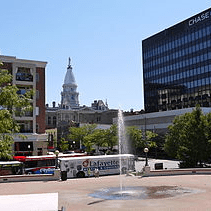
A pastor, who shall remain nameless although an excellent person, commiserated with people who were to go to the diocesan convention in Terre Haute, Indiana.  The city is not well known as a place for fun and frolic;  it is an industrial city bordered roughly by a residential district and the Indiana State University campus on the north side, the Wabash River to the west and suburban retail sprawl to the south.  US 41 is the main north-south drag while the old National Road leads east toward Indianapolis.

The city was quiet today.  The students at ISU have gone home.  The brutal cold snap earlier this week went east and seasonably mild weather under bright, low sunshine  replaced it.

My first destination was the CANDLES Holocaust Museum founded by Eva Mozes Kor.  In 1944 her family was sent to a ghetto in Romania, and from there to Auschwitz-Birkenau in Poland.  She ended up in Terre Haute because followed her husband, himself liberated from Buchenwald to the city of her husband Michael’s American rescuer and mentor.  With fears that “Never Again!” died with most of the Greatest Generation, I hoped to learn how Americans of good will can head off a repeat of the Hitler years.  For should America go mad, who would liberate us?

The second destination was the Eugene V. Debs house on the ISU campus, which was closed.

There were some interesting sites and signs on the trip from Lafayette to Terre Haute, and more interesting things to see on the indirect trip back…stay tuned.

Welcome to the Tippèd Canoe

Greater Lafayette and its surrounding counties actually have many progressive threads in their history, and the purpose of this blog is to bring some of these threads out.  It just does not seem right that the city where four Underground Railroad routes met is represented by Todd Rokita or that its county voted for Trump.

For there is a decency and sense of fair play fundamental to most Hoosiers (at least along and north of I-70) that lies slumbering.  We are, after all, the state that sent Mike Pence with his tail between his legs.  We have seen bad Trumpian behavior, but the self-celebrated islands of tolerance like Massachusetts, New York, Minnesota and California have seen worse rates of hate, if the Southern Poverty Law Center is to be believed.  We are the Union state to whom its Confederate POWs erected testimonials to their guards.  We are the city whose people, in 1838, raised objection to the cleansing of Potawatomi from their homes and the state that, while racked with a rising Klan fever, erected a monument denouncing the crime in 1922.

So the purpose of this site is partly to resurrect some of the glories of Indiana’s past — to Make Indiana Great Again.  It wants to do so by helping clean out the Statehouse.  It stands in implacable opposition to the legion of suborned pulpits which plague our state and stunt its people, though we cherish the many churches which have stood with the poor and the marginalized as they have for over 150 years.  We aim to turn out the “good ole boys” clubs whose mean ambition is to rake off a share of our toil and our sweat that we eport to the coasts along with our most promising youth.

H/T to the Reader’s Digest, whose byline “An Article a Day of Enduring Significance” inspired this blog’s.